5 August 2026
Open a Trust in New Zealand
If you want to open a trust, our New Zealand company formation experts can also help you with setting up a trust in NZ.

If you are interested in opening a trust in New Zealand to protect your assets, as well as guarantee your control over them, then our team specializing in company formation in NZ can help you through the entire incorporation process.
| Quick Facts | |
|---|---|
| Governing Law | The Trusts Act 2019 |
| Trust incorporation in New Zealand | Via a trust deed |
| Trust registration | In the case of charitable trusts. These are entered into the Charitable Trusts Register. |
| Types of trusts | family trusts; charitable trusts; business trusts; foreign trusts, etc. |
| Trustees | Natural and legal persons |
| Number of trustees | No legal minimum applies, however, it is common to set up a trust in New Zealand with at least two trustees. |
| Trustee residency requirements | There are no residency requirements for trustees. |
| The appointment of new trustees | Performed by the person nominated for this purpose or as otherwise provided for in Part 4 of the Trusts Act. |
| Trustee duties | The primary role of the trustee is to act in the best interest of the beneficiaries. |
| Trustee liability | Trustees are liable for failure to meet their fiduciary duties or to comply with the statutory requirements for the trust, liable for breach of trust, etc. |
| Trustee powers | Controlling the assets of the trust in the best interests of the beneficiaries. |
| Court appointed trustees | Under specific cases |
| Beneficiaries | One or more individuals or classes of individuals (for example, children) |
| Trust taxation | Tax is paid on any income that the trust does not distribute to beneficiaries. The rate is 33% or 39%, depending on how much the trust earns in a year. |
| The transmission of property | According to the type of property (for example, land) and the circumstances under which it takes place. |
How is a trust formed in New Zealand?
A trust is established by naming the beneficiaries or defining its permitted purpose and appointing one or more trustees. Its terms are usually recorded in a trust deed, and the arrangement takes effect once the trustees hold and manage the assets in accordance with those terms.
The main steps are:
- Define the trust structure: decide the purpose of the trust, identify the settlor, appoint one or more trustees, name the beneficiaries or classes of beneficiaries, and determine which assets will be placed in the trust. The trust property and the beneficiaries or permitted purpose must be identified with sufficient certainty, while a sole trustee cannot also be the sole beneficiary.
- Prepare and sign the trust deed: the deed records the terms governing the trust, including how the assets will be managed and distributed and what powers the trustees may exercise.
- Transfer the initial assets: the settlor transfers the relevant money, shares, property, or other assets to the trustees. The documents needed for this step depend on the type of asset involved.
- Apply for an Inland Revenue Department number: the trust normally needs its own IRD number for tax-related matters. Where it earns taxable income, it must also submit the applicable trust income tax return.
- Complete any special registration: additional procedures apply when the structure is a New Zealand foreign trust seeking the foreign-income exemption or when the trustees wish to incorporate a charitable trust board.
Once established, all trustees must keep a copy of the trust deed and any later amendments. At least one trustee must also retain records relating to the trust property, trustee decisions, contracts, financial statements, changes of trustees, and any letter of wishes prepared by the settlor.
What documents are needed to establish a trust in New Zealand?
The documents prepared or collected during the formation process include:
- the trust deed, stating the trust’s name, terms, trustees, beneficiaries or permitted purpose, initial property, and rules for managing and distributing the assets;
- documents appointing the trustees, when their appointment is not fully covered by the trust deed;
- a schedule of the initial trust property, identifying the money, shares, real estate, or other assets placed in the trust;
- documents confirming the transfer of those assets, such as bank-transfer records, share-transfer forms, assignments, or property-transfer documents;
- a letter or memorandum of wishes, when the settlor wishes to provide non-binding guidance to the trustees;
- the IRD number application and a copy of the signed trust deed, when registering the trust for tax purposes. The deed submitted for an IRD-number application should show the trust’s name, the trustees’ signatures, and its date.
After the trust is established, all trustees must retain the trust deed and any documents that set out or amend its terms. At least one trustee must also keep records relating to the trust property, trustee decisions, contracts, financial statements, changes of trustees, and any letters of wishes.
What are the parties to a trust in New Zealand?
A trust is set up by a party for the benefit of one or more other parties. The following are involved:
- The settlor: the person who opens the trust and places the initial assets; any person who transfers assets into the trust is the settlor;
- The trustee: one or more appointed persons who will manage the assets; the settlor entrusts them with this task. While the settlor can also act as a trustee, it may be advisable in some cases to appoint an unrelated party. The use of a public trustee in NZ is possible;
- The beneficiary: one or more individuals who will receive the assets of the trust; the settlor can add beneficiaries as he/she sees fit.
What is an exempt trust in New Zealand?
The New Zealand exempt trust is not subject to taxation in NZ on its foreign-sourced income. For this type of trust in New Zealand, only locally sourced income (i.e., income derived from NZ) is subject to taxation.
When setting up this type of trust, the law allows the appointment of a private trust company as the trustee of the exempt trust. Additionally, the private trust company can perform the role of trustee for the same family that sets up more than one NZ public trust.
What advantages do I have if I open an exempt trust in New Zealand?
We present some of the advantages of setting up an exempt trust in New Zealand and of investing in NZ in general:
- Flexible laws: NZ imposes a set of provisions that favour investments and encourage entrepreneurs who want to start a business in New Zealand. The trust law grants sufficient powers to the professional investment management business that oversees the fund and, at the same time, the trustee remains responsible for certain compliance matters;
- Tax benefits: New Zealand has signed forty double taxation agreements. These allow for the reduction of certain types of taxes and the avoidance of double taxation between NZ and the other signatory states. Examples of such countries include: Australia, Austria, Belgium, Canada, Denmark, France, Germany, Hong Kong, Italy, Japan, Korea, Russia, Singapore, South Africa, Thailand, the UAE and others;
- Estate planning: the flexible regime applicable to trusts makes easy to retain a corporate trustee. This can be a key advantage for the transfer of wealth across generations.
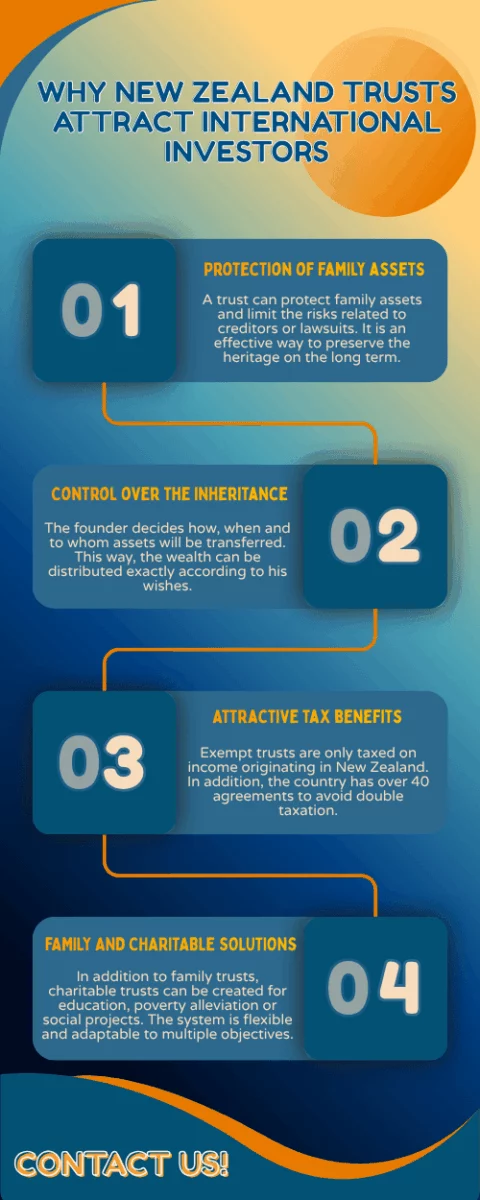
Discover in a few key ideas why trusts in New Zealand are an attractive solution for wealth protection and future planning from the infographic below:
Why do I open a family trust in NZ?
A family trust can be a useful tool to protect the assets of your family. Some reasons why you can consider opening a family trust in New Zealand include the following:
- protect certain assets for your family members;
- make sure that the family’s business is transferred to the next generation;
- control how some assets are transferred, and to whom;
- more straightforward estate administration;
- asset and creditor protection;
- retirement savings and planning;
- cross-border asset management;
- privacy;
- philanthropic purposes.
What issues do I have to consider about the duration of a trust in New Zealand?
Some important issues to consider about the duration of a trust in New Zealand include:
- The new Trusts Act changed the maximum duration of a trust to 125 years (before the Trusts Act 2019 came into force on 30 January 2021, the maximum duration was generally 80 years);
- Trusts that were formed before the new law came into force may or may not be extended from 80 to 125 years; our New Zealand company formation agents can give you more details.
Who can establish a charitable trust in New Zealand?
Individuals or organizations that wish to dedicate money, property, or other assets to charitable purposes may establish a charitable trust in New Zealand. The trust is managed by one or more trustees in accordance with its trust deed, and its activities must provide a public benefit rather than a private financial advantage.
What purposes can a charitable trust support?
The settlor determines the trust’s objectives and explains in the trust deed how its funds and assets will be used. Under New Zealand law, recognized charitable purposes include:
- education promotion;
- religion promotion;
- poverty relief;
- other purposes that benefit the community.
Unlike a family trust, or a trust opened to protect the assets of an individual (and to control how these are distributed), the charitable trust must exist solely for charitable purposes.
The law governing these types of trusts in New Zealand is the Charitable Trusts Act. According to the regulations, a charitable trust has a trust board that follows the trust deed. Both the trust deed and the trust board are included in the Registrar for these trusts. Our team, which can help you start a business in New Zealand, can also help you set up a charitable trust.
What documents should trustees keep?
If you open a trust in New Zealand, you will need to keep the trust deed, any later amendments, and records showing how the trust has been administered. These records normally cover the trust’s assets, financial and accounting information, contracts, trustee decisions, changes in trustees, and any written wishes left by the settlor.
Not every trustee has to hold a full copy of every document, but at least one of them must retain the complete set and make it available to the others when required. When a trustee leaves or is replaced, the relevant records must be passed to a continuing or newly appointed trustee.
What are the reporting duties of a New Zealand foreign trust?
A New Zealand foreign trust that wishes to benefit from the tax exemption available for qualifying foreign-sourced income must comply with the following registration and reporting duties:
- Initial registration: the contact trustee must register the trust with Inland Revenue and provide its Inland Revenue Department number (IRD number), the trust deed and any amendments, as well as information about the persons connected with the trust.
- Annual return: the trust must submit an annual return together with the required financial statements and information about settlements made during the year.
- Distributions and beneficiaries: the annual return must also identify any distributions of money or assets, new settlors, and beneficiaries who received funds or property from the trust.
- Consequences of non-compliance: failure to meet these obligations may lead to the loss of the exemption for foreign-sourced income and the imposition of a civil penalty.
What information should I, as a trustee, provide to beneficiaries?
Under the Trusts Act 2019, trustees are expected to keep beneficiaries informed about the trust and the rights they have in relation to it. The basic information normally provided includes:
- confirmation that the person is a beneficiary of the trust;
- the names and contact details of the trustees;
- details of any trustee who has been appointed, removed, or has retired;
- information about the beneficiary’s right to request the terms of the trust and other documents concerning its administration.
Disclosure is not automatic in every situation. Before releasing the information, trustees must consider the factors listed in section 53 of the Act and may decide to withhold some or all of it when the circumstances justify this approach.
Contact us if you want to know more about how to setup, change, or dissolve a trust in New Zealand.